66.3% of Battery Powered Lawn Mowers Overstate Advertised Runtimes - An Audit of 178 Mowers
Executive Summary
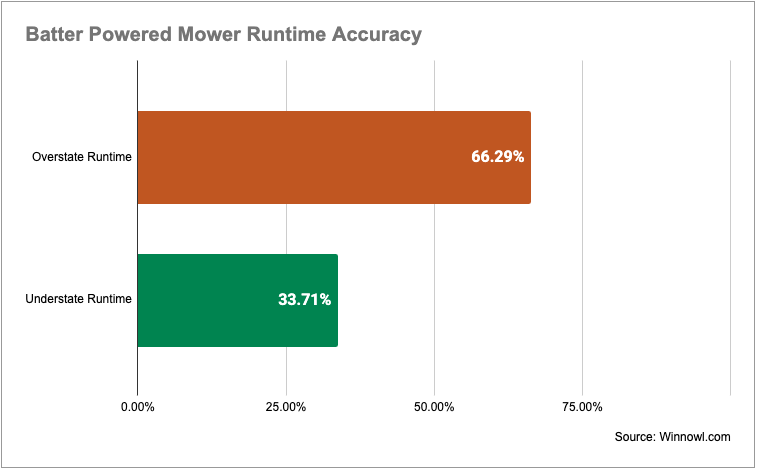
An empirical audit of 178 battery-powered lawn mowers across 53 brands reveals a systemic split in retail runtime claims. Across the full 178-model index, 66.29% of mowers (118 models) overstate operational runtime by an average of 34.20% when evaluated against Winnowl’s deck-calibrated continuous load models.
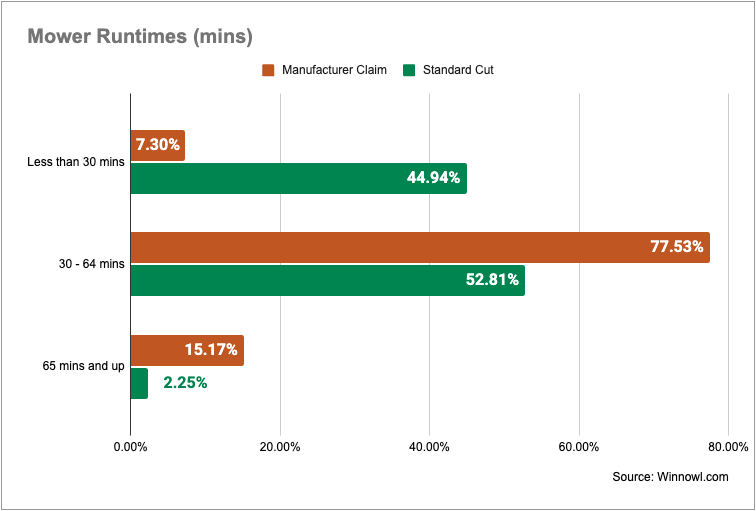
By relying on low-resistance "air-cut" laboratory tests that assume low average loads, manufacturers inflate performance figures beyond practical conditions. While manufacturers advertise that all but 7.3% of mowers are capable of a 30-minute or greater runtime, applying standard cut loads shows that 28.09% of mowers lack the watt-hour reserves to finish the job on a single charge. Concentrated heavily in standard 4 Ah to 10 Ah consumer battery packs, these rating practices may leave many buyers with equipment that falls short mid-cut.
Key Audit Findings
1. Nearly Two Thirds Overstate Runtime
Across the entire 178-model index, 66.29% of mowers (118 models) overstate operational runtime by an average of 34.20% under Winnowl’s deck-calibrated load models. Overstatement spans both mower types, affecting 54.26% of push mowers (51 of 94) and 79.76% of self-propelled mowers (67 of 84). While a subset of push and self-propelled mowers publish conservative runtimes, the overall market remains severely unstandardized, leaving two out of every three buyers with less cutting time than advertised.
2. Larger Runtime Gap in Standard Battery Packs (4–10 Ah)
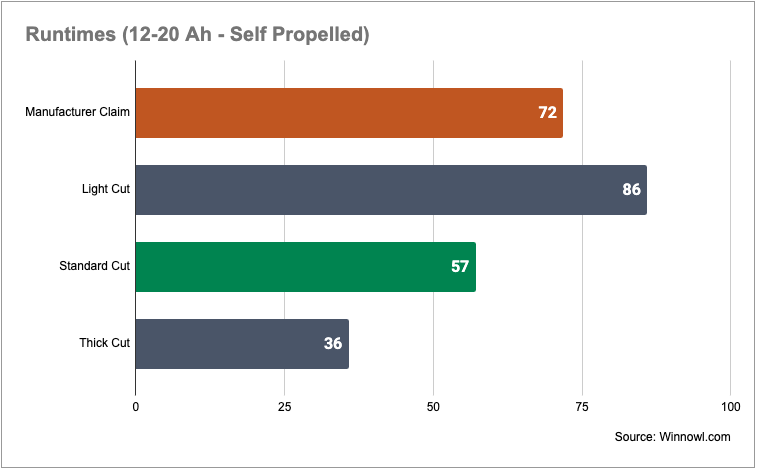
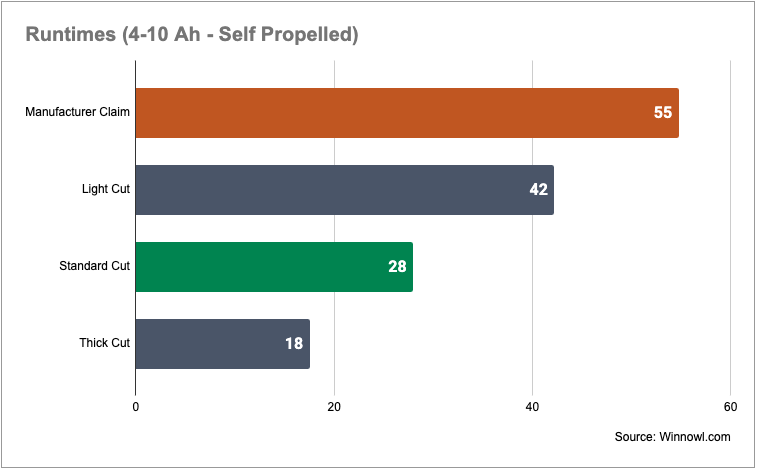
The operational gap in self-propelled mowers is heavily concentrated in standard consumer battery configurations (4 Ah to 10 Ah total pack capacity). Across 65 audited models in this tier, manufacturers advertise an average runtime of 55 minutes, but applying continuous blade-and-drive load models yields a calculated standard cut runtime of 38 minutes—a 30.91% continuous load variance. Conversely, high-capacity commercial-grade packs (12 Ah to 20 Ah) absorb drive-motor loads effectively, delivering a modeled average of 77 minutes against a 72-minute claim.
3. "Air Cut" Testing Loads
The gap in self-propelled runtimes traces directly to the load assumptions built into retail claims. For push mowers, manufacturer claims reflect an implied load of 375 Watts, which aligns closely with our modeled 331-Watt standard turf load. However, for self-propelled models in the primary 4–10 Ah consumer segment, retail claims rely on an implied load of 445 Watts—failing to capture the continuous drive draw. Applying our deck-calibrated 573-Watt standard load reveals a 128-Watt operational deficit in retail testing baselines.
4. The 30-Minute Operational Threshold Gap
While 92.70% of mowers in the dataset advertise runtimes of 30 minutes or longer (suggesting sufficient capacity for a standard 1/4-acre lawn), continuous load modeling reveals that 28.09% of all audited models fail to reach 30 minutes under standard grass drag.
The objective of this white paper is to present empirical baseline data to assist journalists, researchers, and consumers in evaluating cordless battery-powered lawn mower platforms using energy-capacity physics rather than unstandardized retail claims.
Detailed Data Analysis
1. Nearly Two Thirds Overstate Runtime
Applying continuous engineering load models across the 178-mower dataset reveals a deeply unstandardized market where nearly two-thirds of all models fail to deliver advertised runtimes.
For manual push mowers (n = 94), over half the category—54.26% (51 models)—overstates runtime claims, averaging a 38.33% field deficit (49 minutes claimed vs. 30 minutes calculated). The overall push category average appears balanced only because the remaining 45.74% (43 models) understate their runtime by an average 45.9% (37 minutes claimed vs. 54 minutes calculated). This split demonstrates that retail push claims lack any standardized testing baseline.
Across 84 self-propelled units audited, 79.76% (67 models) have lower modeled runtimes than retail estimates. While manufacturers advertise an average runtime of 59 minutes for these units, applying combined blade-and-drive loads (450–850W depending on width) reduces calculated delivery to 41 minutes—a 31.61% operational deficit. This occurs because factory zero-load testing often omits the continuous watt-hour draw required to power drive wheels against turf drag.
2. Capacity Sensitivity in Standard Battery Packs (4–10 Ah)
Segmenting the 84 self-propelled units by total energy capacity reveals the primary gap sits within standard consumer configurations utilizing 4 Ah to 10 Ah battery packs. Representing 65 of the audited units, this tier forms the core of residential retail offerings. While retail specifications cite an average runtime of 55 minutes for this group, continuous load modeling—combining standard blade resistance with self-propulsion drive draw—calculates an average continuous delivery of 38 minutes. This establishes a 30.91% calculated runtime deficit under sustained operating conditions.
This sensitivity occurs because the fixed power demand of a self-propulsion drive system (typically consuming 150W to 250W continuously) consumes a significantly higher proportion of total stored Watt-hours in a 4–10 Ah pack than in larger systems. By contrast, high-capacity commercial-grade packs (12 Ah to 20 Ah total capacity across 19 audited units) provide sufficient energy overhead to absorb continuous drive draw. For these higher-capacity units, continuous engineering load models yield a calculated average delivery of 77 minutes against a 72-minute retail claim, aligning within -6.94% of manufacturer baselines.
3. "Air Cut" Testing Loads
The dataset's baseline group—push mowers in the 4–10 Ah range (92 units)—shows more accurate testing loads. Manufacturers base their push claims on an average implied load of 375 Watts. Compared to our modeled 331-Watt standard average cutting load, that minor 40-Watt difference confirms that push mower ratings accurately account for manual mowing under standard grass resistance.
The gap shows up exclusively in self-propelled models, specifically within the core 4–10 Ah consumer category (65 units). To hit an advertised 55-minute runtime, retail claims in this group rely on an implied load of just 445 Watts—adding only 75 Watts over a push mower to run both the cutting blade and the drive motor. In contrast, applying our deck-calibrated models requires an average standard load of 573 Watts. This 128-Watt gap drops modeled delivery from the claimed 55 minutes to just 38 minutes—a 30.91% variance that shows retail claims evaluate drive systems under minimal drag, leaving out the real power required to push wheels through standard grass.
4. The 30-Minute Operational Threshold Gap
Retail packaging and product listings heavily emphasize a 30-minute runtime as the minimum benchmark for single-charge residential mowing. Across the 178 audited mowers, 165 models (92.70%) cite advertised runtimes of 30 minutes or longer, with 138 models claiming between 30 and 64 minutes. On paper, less than 8% of the market acknowledges a sub-30-minute operating window.
Applying deck-calibrated engineering load models shifts those performance curves significantly. Under continuous standard cutting loads, the number of mowers delivering under 30 minutes jumps from 13 to 50 models—meaning 28.09% of the dataset falls short of the 30-minute operational threshold. This gap is most pronounced in the 4–10 Ah self-propelled category: while zero manufacturers in this tier advertise a runtime under 30 minutes, continuous load calculations show that 15 of the 84 self-propelled units (17.86%) drop below 30 minutes once the energy required to power the drive wheels is factored into total battery drain.
Case Study: Greenworks 40V vs 80V Comparison
A side-by-side look at two mowers from the same brand highlights how retail runtimes can diverge from real-world performance. Consider two 21-inch mowers from Greenworks: the 40V 5.0 Ah (LMF414) and the 80V 4.0 Ah (MO80L416). The manufacturer product listings cite the lower-voltage 40V mower with a 60-minute runtime, while the higher-capacity 80V model claims only 33 minutes. Evaluating the battery math under a standardized 21-inch cutting load reveals a completely inverted reality.
The Greenworks 40V (5.0 Ah) pack delivers 180 Watt-hours of usable energy after applying Winnowl standard battery management cutoffs. Under Winnowl’s standard 560-Watt continuous load benchmark for 21-inch decks, this battery delivers roughly 19.3 minutes of operation. To hit its advertised 60-minute rating, the mower would need to draw a continuous load of under 180 Watts—a minimal-resistance state achieved only under zero-load conditions without self-propulsion engaged.
View on Greenworkstools.comView on Amazon.com
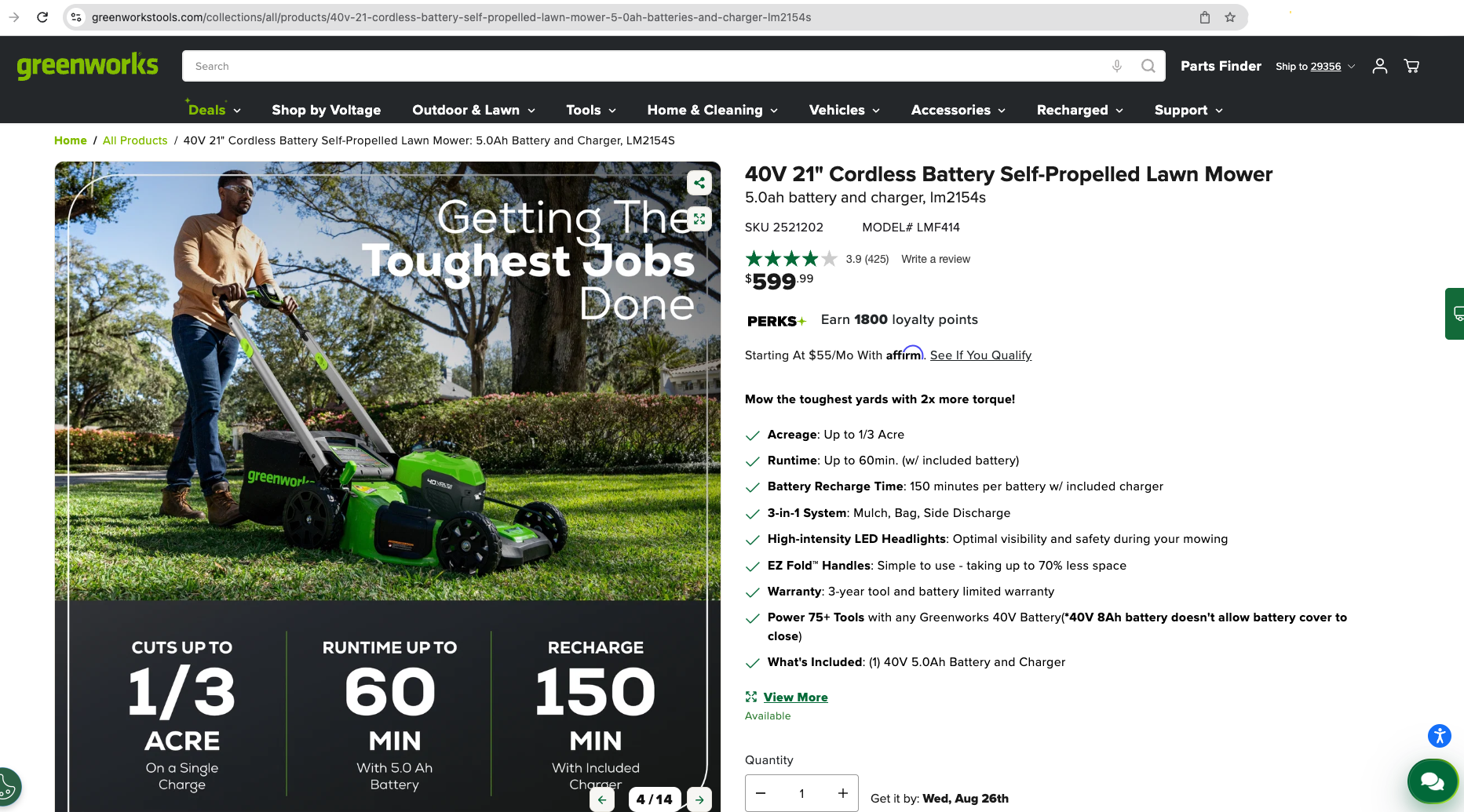
Source: Manufacturer product page as captured August 2026.
Conversely, the Greenworks 80V (4.0 Ah) pack delivers 288 Watt-hours of usable energy—providing +60% more total fuel despite carrying a lower Amp-Hour rating on the label. Applying the same 560-Watt continuous load model yields 30.9 minutes of cutting runtime under standard grass resistance. While the 80V model clears the 30-minute benchmark for a standard quarter-acre yard, the 40V model falls well short, requiring at least one battery swap to complete the same job.
View on Greenworkstools.com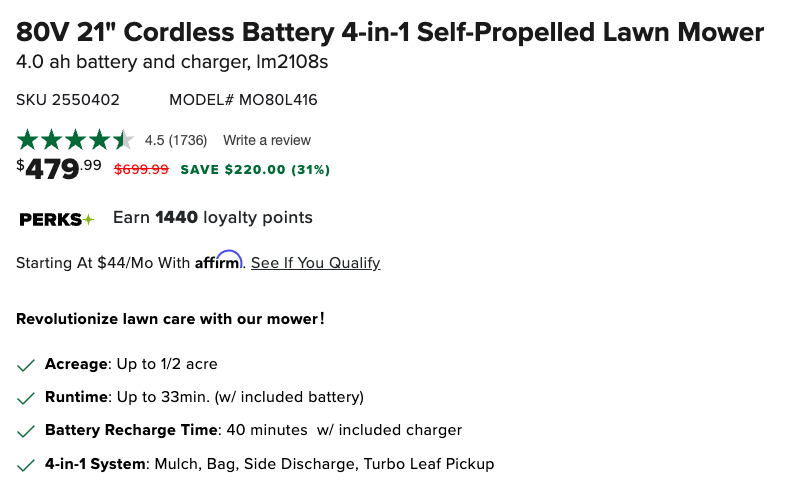
Source: Manufacturer product page as captured August 2026.
This runtime discrepancy is far from unique to Greenworks. Across 178 models audited within the Winnowl Index, 28.09% of all battery-powered mowers failed to meet the 30-minute operational threshold required for a standard quarter-acre yard under standard cutting loads. Across the all mowers in the data set, advertised retail runtimes exceeded calculated turf runtimes by an average of 13.73% when evaluated under Winnowl’s deck-calibrated continuous load models.
Customer feedback confirms this performance gap. In a 3-star review on Greenworks' website, a buyer noted:
Customer:
"...my new Greenworks Lawnmower lasts about 15-20 minutes of run time... Seeing the Greenworks lawnmowers in Walmart advertising 60 minutes of run time and I'm not even getting half of that is not good at all."
The official manufacturer response shows that retail ratings across the market frequently rely on minimal-resistance baselines.
Official Greenworks Customer Service Response:
"With a 2.0Ah battery, a runtime of approximately 15–20 minutes under load (especially with self-propel engaged) is generally within the expected range for this battery size... We do want to clarify that the 'up to 60 minutes' runtime shown in some marketing materials is based on light-load testing conditions (higher cut settings, minimal resistance, and no self-propel use), which is why real-world performance can differ..."
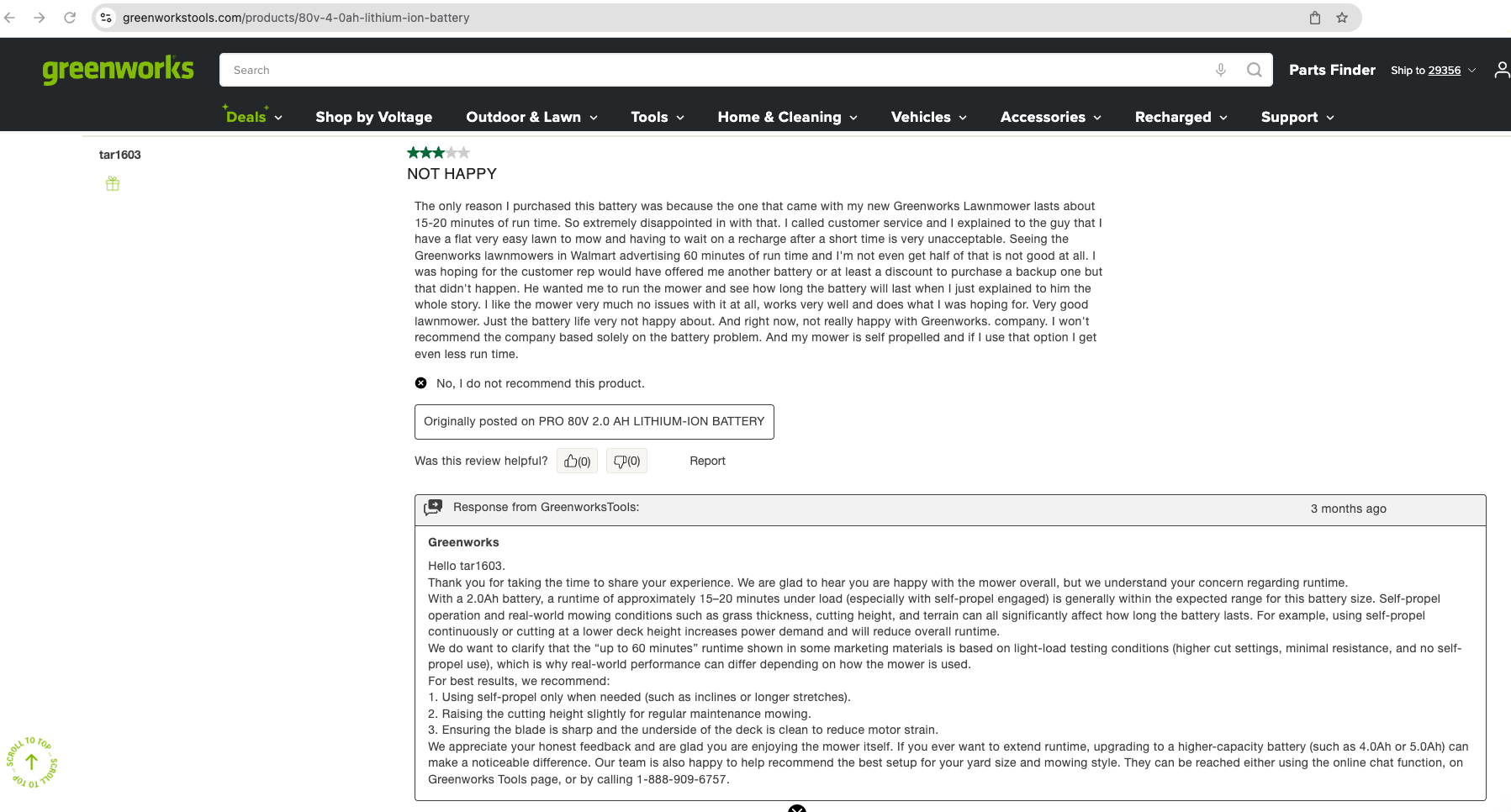
Source: Manufacturer product page as captured August 2026.
| Specification | Greenworks 40V 21" (5.0 Ah) | Greenworks 80V 21" (4.0 Ah) | Platform Variance / Impact |
|---|---|---|---|
| Advertised Runtime | 60 Minutes | 33 Minutes | 45% Difference |
| System Voltage | 40 V (Nominal 36V) | 80 V (Nominal 72V) | 80V Platform +100% Voltage |
| Gross Battery Capacity | 5.0 Ah (200 Wh) | 4.0 Ah (320 Wh) | 80V carries +60.0% gross energy |
| Usable Energy (90% BMS) | 180 Wh | 288 Wh | 80V delivers +60.0% usable fuel |
| Winnowl Baseline Load (21") | 560 Watts | 560 Watts | Standardized deck resistance load |
| Calculated Turf Runtime | 19.3 Minutes | 30.9 Minutes | 40V platform falls 67.8% short of claim |
| 1/4-Acre Status (30 Min) | FAIL | PASS | 40V requires battery swap |
53 Audited Brands
Over 53 brands and their products were analyzed in this audit and include the following:
Consumer & Industry Implications
The empirical gap between laboratory "no-load" claims and continuous field performance creates immediate operational friction for homeowners, highlighting the need for modernized reporting standards across the outdoor power equipment industry.
A. The Practical Impact on Consumers
- Mid-Mow Delays and Disrupted Workflows: A standard quarter-acre lawn requires roughly 30 minutes of continuous active cutting. Buying a mower based on an advertised 40-minute claim often results in battery depletion with 10% to 25% of the lawn still standing once standard grass resistance and continuous self-propulsion are introduced. Because standard chargers require 60 to 120 minutes to cool down and recharge a depleted pack, a minor energy deficit transforms a simple 30-minute chore into a multi-hour project.
- The Failure of the "Advertised Minute" Metric: Because manufacturer runtime inflation is non-linear and heavily concentrated in smaller battery capacities, advertised minutes are an unreliable benchmark for buying decisions. Rather than relying on retail claims, consumers must evaluate true hardware fundamentals—specifically total Usable Energy ($Wh$) after BMS cutoffs—to ensure a mower carries enough actual fuel to complete their property on a single charge.
B. Practical Buyer’s Guide: Minimum Specifications for 1/4-Acre Lots
To sustain 30 minutes of continuous cutting on a standard 21-inch deck, a mower requires sufficient battery capacity to support its baseline continuous operational load—480 Watts for push models (240 Wh usable energy) and 560 Watts for self-propelled models (280 Wh usable energy, accounting for active drive-motor draw). Accounting for standard 90% Battery Management System (BMS) reserve cutoffs, minimum required gross battery capacity shifts based on drive configuration and system voltage platform.
| 30 min (1/4 acre) Battery Requirements - 21" Lawn Mower |  |
|||
|---|---|---|---|---|
| System Voltage Platform (Nominal) | Push Mowers (480W Load) | Self-Propelled Mowers (560W Load) | ||
| Min. Capacity | Passing Pack Setup | Min. Capacity | Passing Pack Setup | |
| 36V / 40V Max (36V Nom.) | 7.4 Ah | (1) 7.5 Ah or (2) 4.0 Ah | 8.6 Ah | (1) 10.0 Ah or (2) 5.0 Ah |
| 56V (56V Nom.) | 4.8 Ah | (1) 5.0 Ah or (2) 2.5 Ah | 5.6 Ah | (1) 6.0 Ah or (2) 3.0 Ah |
| 72V / 80V Max (72V Nom.) | 3.7 Ah | (1) 4.0 Ah or (2) 2.0 Ah | 4.3 Ah | (1) 5.0 Ah or (2) 2.5 Ah |
C. Recommendations for Industry Reporting Standards
- Standardized Continuous Wattage Testing: Just as the automotive sector relies on EPA fuel economy cycles and projector manufacturers publish ANSI lumens, the outdoor power equipment industry needs a unified testing framework. Runtimes must be certified against standardized continuous mechanical resistance loads (such as Winnowl's 480W push and 560W self-propelled baselines) rather than zero-load blade rotation in open air.
- Dual-Label Retail Transparency: Manufacturers should adopt dual-rating package labels displaying both "Maximum No-Load Runtime" (air-cut) and "Standard Turf Certified Runtime" under calibrated load.
- Acreage Coverage Ratings Based on Usable Energy: Retail packaging should state estimated yard coverage using true Usable Energy ($Wh$ after standard 90% BMS reserve cutoffs) mapped directly to real-world turf benchmarks (e.g., "Certified for up to 1/4-Acre / 7,000 sq ft under 560W load").
Background & Industry Status Quo
The Shift to Battery Powered OPE
Over the past decade, regulatory phase-outs of small spark-ignition engines alongside consumer demand for lower noise and zero direct emissions have accelerated the adoption of lithium-ion outdoor power equipment. Modern 40V Max, 56V, and 80V Max cordless platforms are marketed as direct replacements for standard 140cc to 160cc gas mowers.
The Significance of the 30-Minute / 1/4-Acre Benchmark
In residential battery mower marketing, a 1/4-acre lot (10,890 square feet) serves as the primary benchmark for suburban property sizing. Accounting for house footprints, driveways, patios, and landscaped beds, a typical 1/4-acre lot yields approximately 7,000 square feet of actual turf grass.
Using a standard 21-inch mower deck with customary 2-inch pass overlaps and turnaround deceleration, an operator maintaining a standard 2.5 mph walking pace requires precisely 30 minutes of continuous active cutting time to complete 7,000 square feet of turf.
This 30-minute operational threshold represents a critical user experience boundary:
- Above 30 Minutes: The battery pack carries sufficient Usable Energy to complete the property on a single charge cycle without thermal throttling or shutdown.
- Below 30 Minutes: The pack depletes mid-mow. Because standard OPE fast chargers require an initial 15-to-30-minute cell cooldown phase before initiating a 60-to-120-minute recharge cycle, falling short by even 3 to 5 minutes delays property maintenance by hours.
Methodology & Physics-Based Framework
To establish an objective baseline for cordless mower performance, this audit relies on a physics-based framework that evaluates usable battery energy capacity against standardized electrical power demands across distinct cutting conditions.
Usable Energy Capacity
Batteries store energy measured in Watt-hours (Wh), calculated as nominal voltage multiplied by total Ampere-hour capacity ($V \times Ah$). For dual-battery mowers, total Ah represents the combined capacity of all included battery packs (for example, two 5.0 Ah batteries yield a total capacity of 10.0 Ah). However, lithium-ion battery management systems (BMS) restrict full discharge to prevent permanent cell degradation, thermal runaway, and over-discharge voltage collapse.
In this audit, Usable Energy is defined using a standard 90% capacity utilization factor:
Usable Energy (Wh) = (Nominal Volts × Ampere-hours) × 0.90
For example, a 56V, 5.0 Ah battery pack has a nominal theoretical capacity of 280 Wh, but yields 252 Wh of usable energy under continuous discharge before BMS cutoff.
Standardized Operational Load Tiers
When a lawn mower engages grass blades, the electric motor experiences continuous mechanical drag. To maintain a constant blade tip speed under load, the motor controller increases current draw ($I$), elevating real-time electrical power consumption measured in Watts ($W = V \times I$).
Because the volume of turf processed per second scales directly with cutting deck width, continuous wattage demand is not uniform across a mechanical class. Sweeping a 21-inch path demands substantially higher rotational torque than a 14-inch path under identical turf conditions. Furthermore, self-propelled platforms incur an additional constant baseline draw to power the drive axle motor, independent of blade resistance.
To account for these physical mechanics, this audit establishes a width-indexed operational load matrix across three standardized cutting conditions:
- Light Cut: Low-density, dry turf or maintenance trimming requiring minimal motor torque.
- Standard Cut: Average residential grass density (1.5 to 2.0 inches removed) at standard walking speeds. Represents baseline weekly maintenance.
- Stress Benchmark: Dense, damp, or overgrown spring turf placing sustained high-torque demand on motor drive electronics.
Continuous Operational Power Draw Matrix (Watts by Deck Width)
Operational continuous power draw (Watts) assigned to each audited model based on deck size and mechanical drive class:
| Deck Width (Inches) | Push Mowers (Blade Only) | Self-Propelled Mowers (Blade + Drive Axle) | ||||
|---|---|---|---|---|---|---|
| Light (W) | Standard (W) | Stress Benchmark (W) | Light (W) | Standard (W) | Stress Benchmark (W) | |
| 9" | 120 | 200 | 320 | — | — | — |
| 13" | 140 | 220 | 360 | — | — | — |
| 14" | 140 | 220 | 360 | — | — | — |
| 15" | 200 | 320 | 520 | — | — | — |
| 16" | 200 | 320 | 520 | — | — | — |
| 17" | 200 | 320 | 520 | — | — | — |
| 18" | 210 | 350 | 550 | 300 | 450 | 650 |
| 19" | 280 | 440 | 660 | 320 | 480 | 680 |
| 20" | 280 | 440 | 660 | 380 | 520 | 700 |
| 21" | 320 | 480 | 650 | 400 | 560 | 750 |
| 22" | — | — | — | 420 | 580 | 780 |
| 25" | — | — | — | 500 | 750 | 1,050 |
| 26"+ | — | — | — | 600 | 850 | 1,200 |
Mathematical Model for Expected Runtime
Expected continuous runtime in minutes (Trun) is calculated by dividing total Usable Energy by continuous wattage demand (Pload):
Trun = (Usable Energy / Pload) × 60
Conversely, the implied continuous load claimed by a manufacturer (Pclaimed) is derived directly from its advertised runtime (Tmfr):
Pclaimed = Usable Energy / (Tmfr / 60)
Across the audit dataset, manufacturer runtime marketing implies an average continuous draw of only 290 W to 340 W for 21-inch mowers—values that reflect low-resistance open-air blade rotation rather than real-world 480W push and 560W self-propelled operational turf loads.
Spatial Yard Coverage Models (21-Inch Deck Benchmark)
To map runtime minutes directly to real-world property sizes, spatial models assume a standard 21-inch cutting deck operating at an average walking pace of 2.5 mph with a customary 2-inch pass overlap factor and turnaround deceleration.
- 1/4-Acre Lot Benchmark (10,890 sq ft gross): Accounting for structural footprints (house, driveway, patio, and landscaped beds), net turf area averages approximately 7,000 sq ft. At an effective cutting throughput of 233.3 sq ft/min, completing a 1/4-acre lawn requires precisely 30 minutes of continuous active mowing.
- 1/2-Acre Lot Benchmark (21,780 sq ft gross): Net turf area averages approximately 16,000 sq ft (allowing for larger structural footprints and outbuildings). Completing a 1/2-acre property requires 68.5 minutes of continuous active mowing.
Conclusion & Appendix
Conclusion
The empirical audit of 178 cordless lawn mowers confirms that advertised runtimes systematically overestimate performance under standard cutting conditions by an average of 13.73%. While retail marketing implies that 92.69% of mowers are capable of sustaining a 30-minute runtime on included battery setups, real-world continuous load testing reveals that nearly one third (28.09%) fail to reach this baseline threshold.
The severity of this operational shortfall is inversely proportional to battery pack capacity: standard consumer-tier 4.0 Ah to 6.0 Ah packs carry an average 48.92% inflation rate under real-world motor torque, whereas dual-battery configurations and high-capacity 10.0 Ah to 12.0 Ah commercial-grade setups operate within 8% to 15% of retail claims. Establishing standardized continuous-load testing benchmarks—such as Winnowl's width-indexed power draw matrix—is essential to bridging the gap between retail marketing claims and consumer experience as electrification expands across the outdoor power equipment sector.
Appendix A: Formula Reference Guide
- Usable Energy: Usable Energy (Wh) = Nominal Volts × Ampere-hours × 0.90 (accounting for standard 90% BMS reserve cutoffs)
- Expected Real-World Runtime: Runtime (minutes) = (Usable Energy / Continuous Wattage Load) × 60
- Implied Manufacturer Continuous Load: Implied Load (Watts) = Usable Energy / (Claimed Runtime Minutes / 60)
- Turf Coverage Rate (21-Inch Deck at 2.5 mph): Effective Throughput = 233.3 sq ft/min (accounting for standard 2-inch pass overlap and turnaround deceleration)
Appendix B: Audit Summary Reference Tables
Table B1: Class-Wide Load Tier Summary
Push Mowers (N = 94, Avg 6.0 Ah):
- Claimed Runtime: 43 mins (implies 375W average load)
- Light Cut: 65 mins (49.34% understatement)
- Standard Cut: 41 mins (4.65% overstatement)
- Stress Benchmark: 26 mins (39.27% overstatement)
Self-Propelled Mowers (N = 84, Avg 8.5 Ah):
- Claimed Runtime: 59 mins (implies 502W average load)
- Light Cut: 66 mins (11.90% understatement)
- Standard Cut: 47 mins (20.34% overstatement)
- Stress Benchmark: 34 mins (41.23% overstatement)
Total Dataset (N = 178, Avg 7.2 Ah):
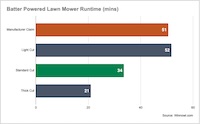
- Claimed Runtime: 51 mins (implies 435W average load)
- Light Cut: 65 mins (28.86% understatement)
- Standard Cut: 44 mins (13.73% overstatement)
- Stress Benchmark: 30 mins (40.34% overstatement)
Table B2: Spatial Yard Capability Breakdown (Standard Cut)
Sub-30 Minutes (Under 1/4 Acre):
- Push: 35 models (37.23% of class)
- Self-Propelled: 15 models (17.86% of class)
- Total Market: 50 models (28.09% of dataset)
30 – 64 Minutes (1/4 Acre to 1/2 Acre):
- Push: 51 models (54.26% of class)
- Self-Propelled: 55 models (65.48% of class)
- Total Market: 106 models (59.55% of dataset)
65+ Minutes (1/2 Acre+):
- Push: 8 models (8.51% of class)
- Self-Propelled: 14 models (16.67% of class)
- Total Market: 22 models (12.36% of dataset)
Note: Continuous load runtimes are calculated using Winnowl’s standardized Usable Energy model (90% BMS cutoff). Field performance will vary based on grass species, moisture content, terrain elevation changes, and blade sharpening intervals.
Rankings