☰ Filters

Battery Powered Push Lawn Mowers Stats

Battery Powered Push Lawn Mowers
  • Total Products Audited: 89
  • Brands Represented: 36
  • Lowest Price: $115.00
  • Typical Price: $219.99
  • Highest Price: $760.00

View Ratings

When you purchase through links on our site, we may earn an affiliate commission.

Market Class Distributions

Winnowl Index Distribution

Rating Level Products Market Share
ELITE 1 1.12%
STRONG 15 16.85%
AVERAGE 30 33.71%
MEDIOCRE 26 29.21%
DEFICIENT 5 5.62%
GHOST 12 13.48%


Performance Distribution

Performance Level Products Market Share
Exceptional 0 0.00%
Strong 28 31.46%
Average 32 35.96%
Mediocre 26 29.21%
Weak 3 3.37%


Market Value Index (MVI) Distribution

Value Tier Products Market Share
Exceptional 4 4.49%
Strong 14 15.73%
Fair 18 20.22%
Mediocre 30 33.71%
Weak 23 25.84%


Brand Strength Distribution

Brand Tier Products Market Share
Exceptional 1 1.12%
Strong 28 31.46%
Average 16 17.98%
Mediocre 30 33.71%
Weak 2 2.25%
Zero 12 13.48%


Price Range Distribution

Price Range Products Market Share
$115 - $199 42 47.19%
$200 - $324 23 25.84%
$325 - $449 18 20.22%
$450+ 6 6.74%

Spec Guide

Click a spec below to see how our experts evaluate these ranges.

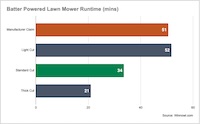
Total Run Time Guide
Range Product Count Market Share Evaluation
Up to 35 minutes 31 34.83% Impact: You will likely struggle to finish a standard suburban lot without stopping to swap batteries or recharge
Analysis: Small-batch endurance. These runtimes are intended for townhomes, patio lots, or small patches of grass under 2,000 square feet.
Over 35 up to 55 minutes 40 44.94% Impact: You should be able to manage a typical quarter-acre property on a single charge if the grass is dry and maintained
Analysis: Standard duty cycle. This endurance level matches the average residential mowing session for most homeowners.
Over 55 up to 80 minutes 13 14.61% Impact: You should effectively clear larger properties or handle thick, overgrown grass that usually drains batteries quickly
Analysis: Extended-range endurance. Provides a necessary safety buffer for thick turf or properties that push the limits of standard battery tech.
Over 80 minutes 0 0.00% Impact: You should be able to tackle massive lots or multiple properties without worrying about the battery cutting out mid-job
Analysis: Commercial-grade runtime. This tier is designed to eliminate "range anxiety" and maximize total work time in the field.
Battery Voltage Guide
Range Product Count Market Share Evaluation
Up to 40 V 70 78.65% Impact: You will likely notice the motor bogging down or stalling when hitting thick patches of clover or tall fescue
Analysis: Entry-level power. These lower-voltage systems are best suited for light-duty maintenance on well-kept suburban lawns.
Over 40 up to 60 V 15 16.85% Impact: You should find the power sufficient for weekly cuts, maintaining consistent blade speed through most standard grass types
Analysis: Standard residential output. This range represents the industry sweet spot for balancing battery weight with reliable cutting torque.
Over 60 up to 80 V 4 4.49% Impact: You should be able to power through dense, wet, or neglected grass with the authority of a small gas engine
Analysis: High-torque performance. Engineered for pro-sumer applications where the motor needs to maintain high RPMs under significant load.
Over 80 V 0 0.00% Impact: You should effectively clear heavy brush and thick stalks that would typically require a professional-grade gas mower
Analysis: Elite voltage tier. This level of power is often overkill for small lots but provides maximum efficiency for challenging terrain.
Warranty Guide
Range Product Count Market Share Evaluation
Up to 2 Years 28 31.46% Impact: You will likely be left with a heavy repair bill if the electronics or motor fail after just a couple of seasons
Analysis: Minimal coverage. Short-term warranties are often a red flag regarding the long-term durability of the battery or control board.
Over 2 up to 4 Years 44 49.44% Impact: You should feel confident that the manufacturer will stand behind the machine for a reasonable portion of its service life
Analysis: Standard industry protection. This coverage aligns with the market average and offers a fair level of consumer security.
Over 4 up to 6 Years 11 12.36% Impact: You should effectively be protected against major hardware failures for nearly the entire life of the product
Analysis: Premium support level. A 4 to 6-year window signals high manufacturer confidence in the build quality and component lifespan.
Over 6 Years 0 0.00% Impact: You will likely replace the mower due to old age before the warranty actually expires
Analysis: Exceptional long-term backing. This level of protection is rare and significantly reduces the total cost of ownership over time.
Charging Time Guide
Range Product Count Market Share Evaluation
Up to 60 mins 13 14.61% Impact: You should be able to recharge a depleted battery during a lunch break and get back to work quickly
Analysis: Rapid recovery tech. High-speed charging systems minimize downtime and are essential for users with limited battery spares.
Over 60 up to 120 mins 57 64.04% Impact: You will likely need to plan your mowing schedule around the charger, as it requires a significant "rest" period
Analysis: Standard charge speed. This turnaround is acceptable for those who finish their entire yard in one go on a single charge.
Over 120 up to 180 mins 7 7.87% Impact: You should expect to wait several hours for a full charge, making it difficult to finish large jobs in a single day
Analysis: Slow-recovery charging. Common in value-tier bundles where the charger lacks active cooling or high-amperage circuitry.
Over 180 mins 3 3.37% Impact: You will likely find this mower out of commission for half the day once the battery hits zero
Analysis: Overnight charging profile. This slow rate is a bottleneck for productivity and indicates a bare-bones charging setup.
Number of Batteries Guide
Range Product Count Market Share Evaluation
Up to 1 count 45 50.56% Impact: You will likely need to purchase a battery as this mower does not come with one
Analysis: No Batter Included. You will have to purchase a battery in order to use this mower.
Over 1 up to 2 count 43 48.31% Impact: You should have just enough power to get the job done, but you lack a backup if the grass is thicker than expected
Analysis: Single-pack baseline. This is the entry point for cordless mowers, providing no hot-swap capability for larger jobs.
Over 2 up to 3 count 1 1.12% Impact: You should be able to swap packs instantly or benefit from double the runtime without returning to the garage
Analysis: Dual-battery advantage. Provides a critical safety net and allows for continuous work on larger residential properties.
Over 3 count 0 0.00% Impact: You should be able to rotate batteries through the charger to maintain near-continuous operation on massive lots
Analysis: Fleet-level redundancy. Having three or more packs ensures that the machine is never the bottleneck in your workflow.
Cutting Height Adjustment Guide
Range Product Count Market Share Evaluation
Up to 5 settings 38 42.70% Impact: You will likely find it difficult to dial in the exact height needed for different grass species or seasonal changes
Analysis: Coarse adjustment range. Limited settings can result in "scalping" the lawn or leaving it too long to look tidy.
Over 5 up to 7 settings 49 55.06% Impact: You should be able to easily adjust the deck to a healthy height for most common residential turf types
Analysis: Standard precision. Offers enough variety to handle the transition from spring growth to summer dormancy.
Over 7 up to 10 settings 1 1.12% Impact: You should effectively fine-tune your cut to match specific lawn care goals, such as training grass for deep roots
Analysis: High-precision deck control. Allows for nuanced turf management that is usually reserved for higher-end landscaping gear.
Over 10 settings 0 0.00% Impact: You should be able to navigate almost any seasonal or terrain-specific height requirement with surgical accuracy
Analysis: Maximum versatility. A double-digit setting count is geared toward enthusiasts who demand total control over their lawn's aesthetic.

Our Ranking Methodology

To calculate the Winnowl Index for these 89 models, we use a data-driven audit based on Dynamic Peer-Group Benchmarking. Our scoring is built on three pillars:

  • Performance - Driven by Usable Energy Capacity, Total Run Time, Battery Voltage, Total Capacity, Cutting Width.
  • Market Value Index - A "Performance-per-Dollar" ratio based on the typical class (median) price ($219.99).
  • Brand Strength - Measures three primary sub-indices: Trust, Reliability, and Customer Support.

Read more about our Methodology